
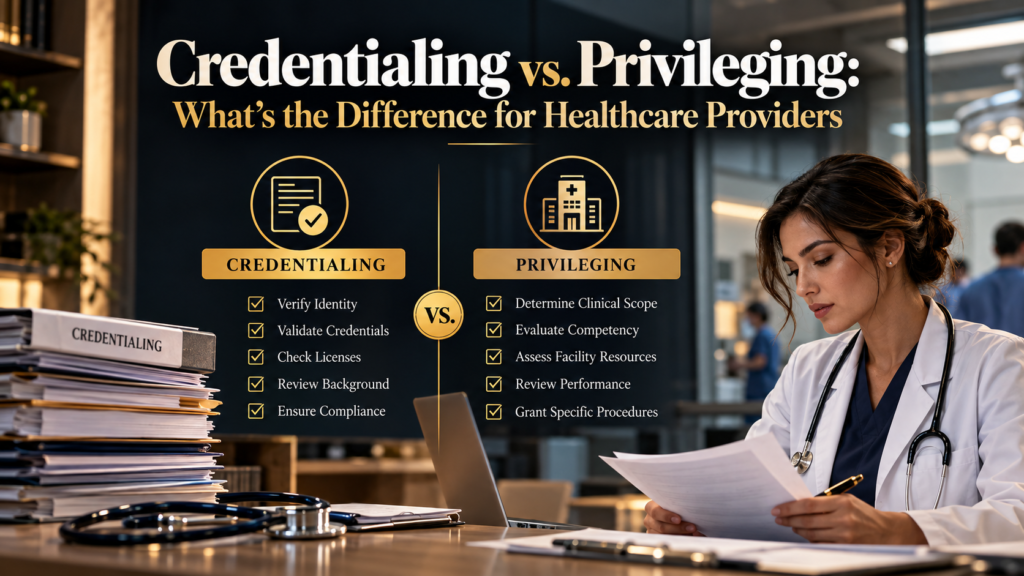
Most healthcare providers throw these two words around like they’re interchangeable. They’re not. That’s actually a pretty big problem. Credentialing compliance and privileging are completely different things that serve entirely different purposes within healthcare organizations. And honestly? Understanding the difference matters more than most people think. This stuff impacts employment, hospital privileges, whether patients are actually safe, compliance issues, the whole thing.
Here’s what catches most providers off guard: you could be fully credentialed but not privileged. Flip it around, someone might have clinical privileges without being credentialed. These aren’t connected the way people assume. They’re independent processes that just happen to get confused constantly.
Medical Staff Credentialing: Verifying Who You Are
Medical staff credentialing is verification work. The core question: who are you? What credentials do you actually have?
Organizations dig into everything. Your medical degree gets verified directly. Your state license gets checked with the licensing board. Malpractice record, DEA registration if applicable, board certification, all confirmed. They search the National Practitioner Data Bank for disciplinary actions.
Usually takes two to three months. Organizations can’t assume anything. They need proof you’re legitimate, documentation showing you are who you say you are, and confidence you haven’t been sanctioned elsewhere. That’s credentialing compliance, nothing assumes, everything verifies.
Credentialing and Privileging: Two Separate Processes
This is where things get messy. Most people assume credentialing and privileging are the same thing. But they’re not. Do they work together? Sure. But they’re completely different things.
Credentialing answers one question: Are you actually who you claim to be? Medical staff credentialing verifies your legitimacy. Your training. Your licenses. Your history. It’s documentation work, basically. Privileging? That’s asking something different entirely. It’s saying: We believe you’re a cardiologist. But can you actually perform stent placements here? Do we have the equipment? Do we have backup coverage? Do your outcomes look good?
Think about a practical example. Someone could be a legitimate, board-certified cardiologist, fully credentialed but your organization might not privilege them to do coronary angiograms. Maybe you don’t have the lab infrastructure. Maybe the outcome data is incomplete. The credentialing process confirmed they’re real. Privileging determines what they’re actually allowed to do in your facility.
Credentialing Compliance Healthcare: The Regulatory Framework
Credentialing compliance in healthcare isn’t optional. The Joint Commission demands it. Medicare demands it. State licensing boards are watching. Everyone has a stake in it.
Organizations need established verification processes, and they need to follow them consistently. Every step gets documented. You’re maintaining current documentation for every provider, re-credentialing every couple of years to ensure nothing’s changed. Disciplinary actions require immediate response. Sanctions go to the appropriate databases.
Most organizations struggle because credentialing compliance in healthcare is resource-intensive. Contacting medical schools, licensing boards, hospitals, and insurance carriers takes time. Some respond slowly. It’s a coordination challenge.
When organizations don’t maintain credentialing compliance healthcare? Joint Commission citations happen. Medicare sanctions. Malpractice insurance restrictions. Accreditation gets lost.
Privileging: Determining Clinical Scope
Privileging’s different. This is clinical authorization, what you’re actually allowed to do in a facility.
Organizations examine specific procedure training, performance history, peer references, and resources. Does your hospital have the equipment? Can you cover emergencies? Credentialing and privileging need alignment.
A provider could be fully credentialed but not privileged for specific procedures. Maybe equipment doesn’t exist. Maybe outcomes data show limited experience. Credentialing healthcare handles verification. Privileging handles clinical reality, who’s safe doing what in your specific setting.
The Timeline and Process Differences
Medical staff credentialing usually moves faster. Sixty to ninety days if things cooperate. Privileging takes longer because it requires subjective evaluation, peer review, credential committee review, and medical executive approval.
Credentialing and privileging don’t move at the same pace. Someone finishes credentialing while privilege is pending. These processes don’t sync up perfectly.
Why This Matters to Providers
Your career? Credentialing compliance healthcare affects it directly. You get a disciplinary action reported during credentialing verification, and it’s going to haunt you for years. References absolutely matter; what people say about you becomes a permanent record. Gaps in licensure matter. Everything. It all gets documented as part of your official professional record.
Then there’s the practical side, privileging impacts your actual day-to-day work. Does your organization deny privileges for certain procedures? That’s limiting your practice, limiting what you can do, limiting income. Credentialing and privileging decisions at each facility determine your scope. You might be privileged in one hospital but restricted in another.
Common Mistakes
Providers treating medical staff credentialing casually are dangerous. It’s not routine paperwork. Incomplete applications delay everything. Inconsistent information raises red flags. Credentialing compliance means organizations verify everything thoroughly.
Another mistake? Assuming credentialing automatically means you get privileges. It doesn’t. These require separate processes and separate approval.
Moving Forward
Credentialing and privileging are foundational to healthcare employment. When providers understand the difference, they navigate it more effectively. Prepare documentation early. Respond fast. Know your organization’s privilege requirements.
Medical staff credentialing establishes baseline legitimacy. Credentialing compliance healthcare ensures regulatory requirements are met. Privileging protects patients by defining clinical scope clearly.
In conclusion, partnering with CNC Medical Billing means your credentialing compliance processes run smoothly and efficiently. Medical staff credentialing gets managed systematically rather than becoming an administrative headache. Credentialing Compliance Healthcare requirements get handled with expertise and attention. Credentialing and Privileging timelines accelerate because someone manages them strategically.
That’s not just administrative processing that’s enabling providers to focus on patient care while compliance runs in the background.