
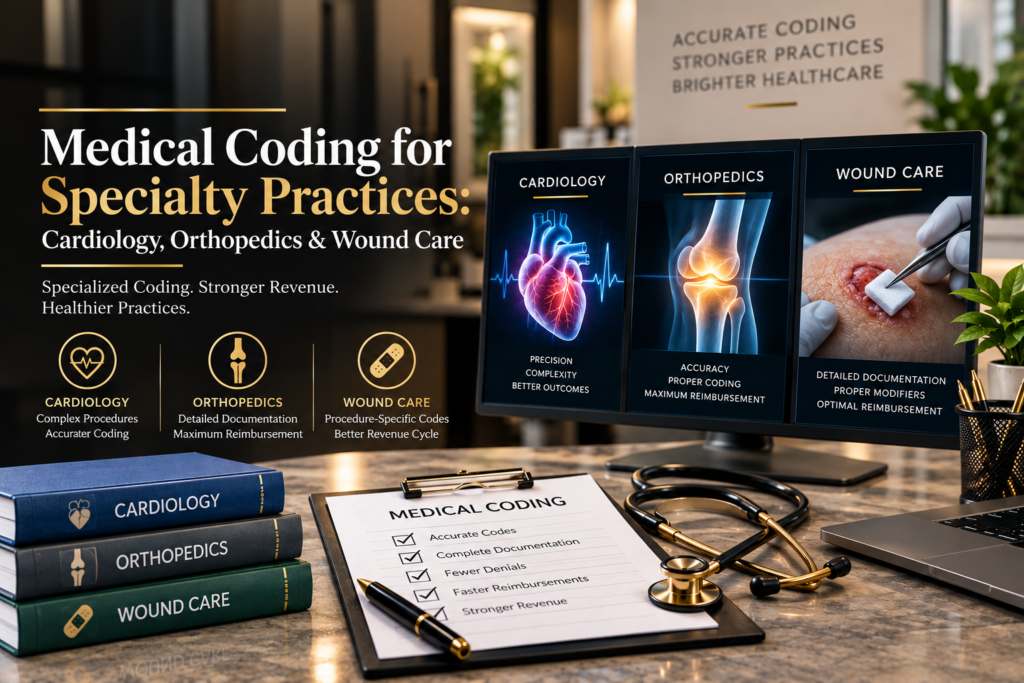
Specialty medical practices operate differently than general care settings. The complexity increases when you’re juggling multiple procedures, diagnostic codes, and payer requirements. That’s where medical billing and coding services become absolutely essential. These practices need accuracy. They need speed. But most importantly? They need someone who actually understands their specialty.
Let’s talk about what makes coding different across three high-demand specialties.
Orthopedic CPT Codes: More Than Just Joint Replacements
Here’s the thing about orthopedics, the work is hands-on, but the coding? It’s intricate. Orthopedic CPT codes cover everything from minor joint injections to complex spinal fusions. Each code tells a story about what the surgeon actually did.
The challenge? Many coders treat orthopedic procedures as generic. They miss the details. A knee arthroscopy with meniscus repair codes differently than simple arthroscopy without repair. The difference? Hundreds of dollars per claim.
Orthopedic CPT codes require understanding of:
- Laterality (left, right, bilateral)
- Specific anatomical locations
- Complexity modifiers
- Bundling rules that vary by payer
Medical coding professionals in orthopedics must know the difference between a code for ligament reconstruction versus ligament repair. One missing modifier, and suddenly a $5,000 claim gets denied or downcoded to $2,000.
Medical Coding for Cardiology: Understanding Complex Procedures
Cardiology presents its own challenges. Catheterization procedures. Ablations. Stent placements. Each involves precise coding sequences that directly impact reimbursement.
Medical coding in cardiology requires knowing:
- Vessel selection and access points
- Injection protocols and contrast studies
- Device types and specifications
- Complication documentation
Consider a cardiac catheterization with angiography and stent placement. The cardiology medical coding requires at least three separate codes working together. Get one wrong, and the entire claim structure falls apart.
Cardiology medical coding also demands attention to payer-specific rules. Medicare reimburses catheterization differently than commercial insurers. Some payers bundle imaging; others don’t. Your coder needs to know these distinctions cold.
Wound Care Coding: The Overlooked Complexity
Wound care practices often fly under the radar. People assume it’s straightforward. It isn’t.
Wound care coding involves:
- Debridement codes with size-specific modifiers
- Negative pressure therapy codes
- Dressing change documentation
- Infection management procedures
The documentation must match the code, exactly. If your provider documents “extensive debridement” but your coder bills standard debridement, you’ve left money on the table. Worse? The provider’s documentation habits now look inconsistent to payers.
Why Specialty Practices Struggle With Coding
Most billing departments handle multiple specialties. They’re stretched thin. When you’re juggling orthopedic CPT codes, cardiology medical coding, and wound care procedures all day, something suffers.
Specialty practices need coders who’ve invested time in their specific field. Not generalists. Not AI-generated submissions. Real expertise.
The financial impact is real. Undercoding is the biggest revenue killer for specialty practices. A cardiology practice losing just two or three correctly-codable procedures per week? That’s $50,000+ annually.
Documentation: The Foundation of Everything
Here’s what gets overlooked, coding starts with documentation. Your orthopedic CPT codes mean nothing if the provider didn’t document which structure was repaired. Your cardiology medical coding claim gets rejected if the catheterization approach isn’t specified.
Specialty practices must have coders who understand documentation requirements. They should flag incomplete charts before they hit billing.
The Real Difference
When practices partner with specialists who truly understand their area, everything changes. Claims process faster. Denials drop. Revenue improves.
Whether it’s orthopedic CPT codes, cardiology medical coding, or wound care procedures, the principle remains the same: precision matters. Your specialty demands it. Your patients deserve it. Your bottom line depends on it.
That’s not just medical billing and coding, that’s strategic financial management.
Final Word
Specialty medical practices can’t afford mediocrity in coding. The stakes are too high. The regulations are too complex. The financial implications are too significant.
Your coding team should have specialists on staff. They should understand your specific procedures. They should know the people you work with. They should catch documentation gaps before they become denials.
In conclusion, partnering with CNC Medical Billing means your specialty practice gets the specialized attention it deserves. Your orthopedic CPT codes get handled by someone who knows orthopedics. Your cardiology medical coding receives expertise from cardiology specialists. Your wound care claims get submitted with precision and confidence. That’s the difference between average billing and exceptional revenue management.